

Just Who Is Listening Into Your Consultation With Your GP And Taking Notes
AI scribes spreading through GP surgeries as watchdogs raise questions over accuracy and patient data
Doctors say the technology cuts paperwork, but patient groups warn that oversight has not kept pace with rollout.
AI "scribes" that listen to GP consultations and write up the notes are fast becoming part of everyday general practice in England, while concerns about patient data, accuracy and regulation grow.
A Queen Mary University of London study published in June surveyed 598 UK GPs and found 40% were currently using AI scribes, with those users relying on them in an average of 60% of consultations. The researchers described uptake as largely informal rather than coordinated.
NHS England backs the technology. Its guidance says the GP reviews the scribe's output before it is accepted into the patient's record, and supporters point to time savings. One Warwickshire pilot reported 1.46 to 2.78 minutes saved per consultation.
Accuracy concerns
 On 31 August, Healthwatch England warned that 27 different AI scribe products are already in use across the NHS, none regulated as a medical device. It said patients had caught errors including a scribe swapping a prescribed drug for a similar-sounding one. The watchdog said patients, rather than clinicians, had noticed these mistakes.
The evidence has limits. Healthwatch said it was unclear whether AI scribes make summaries more or less accurate than clinicians writing notes without them. A separate survey of UK GPs found that 32% of scribe users reported errors often or always, including 14% with significant-to-critical implications, though it was a self-selected sample and the authors call it exploratory.
Prescription Errors
There is a risk that errors in transcription of the consultation, may lead to inapplicable prescribing of drugs and diagnosis.
Evidence of this has already occurred, as reported by The Guardian Newspaper:
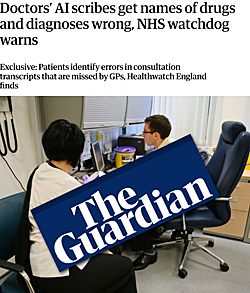 In one case a woman was left badly shaken when the AI scribe’s summary of her conversation wrongly said she had demyelination – serious nerve damage that can lead to multiple sclerosis.
It was only when the patient, an NHS health professional, queried the AI tool’s record of the result of her MRI scan that the hospital corrected it to what it should have been – “null demyelination”.
“This was eventually corrected but was a very traumatising experience to be given an incorrect diagnosis because of AI and then be told it’s a typo,” said the woman, who asked not to be named."
Such inaccuracies may persist in their records if the patient doesn’t immediately spot the error, and even then given that the only way of fidnig this out, is for the patient to utilise the Subjact Access Request process which can take some time.
This puts patient health and in extreme cases, even their lives at risk.
Risks to patient data
Consultations contain some of the most sensitive information people share. NHS-focused legal advice warns that many data risks stem from patient data being stored or processed in externally hosted supplier environments. Guidance for practices says they should make sure all data is processed in the UK and that access to the AI tool is properly controlled. Most scribes delete the transcript once it has been reviewed and copied into the record.
 The BMA's GP committee has stressed that practices, as data controllers, need to understand the risks they take on, particularly while the regulatory landscape is in flux. It advised practices to carry out data protection and clinical safety assessments and check products meet NHS standards.
NHS England has also said practices may still be liable for claims arising from AI use. NHS England now maintains a registry of approved ambient voice suppliers, and practices are advised to use only listed products. Last year, the health secretary acknowledged anecdotal reports of clinicians using ambient AI to record notes before their practice or trust had caught up, which raises the risk of unvetted tools handling patient audio.
Consent
Healthwatch says there is no current requirement for NHS staff to obtain opt-in consent, because the tools support direct care. Yet YouGov polling it commissioned found 81% of respondents want to be told and asked for consent. In the GP survey, 63% of users routinely sought consent.
What patients can do
Patients can ask whether an AI scribe is being used and say if they would rather it wasn't. They can also ask to see what was written in their record and request corrections, particularly to medicines and diagnoses.
Sources:
- Digital Health News (20 June 2025). BMA warns GPs on the 'substantial' risks of AI scribing tools. https://www.digitalhealth.net/2025/06/bma-warns-gps-on-the-substantial-risks-of-ai-scribing-tools
- Pulse (2025). GP liability warning as health secretary pushes use of AI in NHS. https://www.pulsetoday.co.uk/news/technology/gp-liability-warning-as-health-secretary-pushes-use-of-ai-in-nhs/
- London LMCs. Use and adoption of AI ambient scribes in general practice. https://www.lmc.org.uk/resources/use-and-adoption-of-ai-ambient-scribes-in-general-practice/
- GPC England (BMA). Guidance on the use of AI-enabled ambient scribing products in health and care settings: a summary (hosted by Essex LMC). https://www.essexlmc.org.uk/wp-content/uploads/2025/05/GPCE-Guidance-on-the-use-of-AI-enabled-ambient-scribing-products-in-health-and-care-settings-A-Summ.pdf
- Ashfords LLP. AI-enabled ambient scribing in the NHS: benefits, risks and regulatory considerations. https://www.ashfords.co.uk/insights/articles/ai-enabled-ambient-scribing-in-the-nhs-benefits-risks-and-regulatory-considerations
- One Care (Bristol, North Somerset and South Gloucestershire). AI Scribe use in General Practice: patient consent, a plain English explainer. https://www.thefamilypracticewesterncollege.nhs.uk/ai-scribe
- Health Tech Digital (14 July 2025). AI scribes could give GPs back a month each year, new study shows. https://healthtechdigital.com/ai-scribes-could-give-gps-back-a-month-each-year-new-study-shows-nhs-plan-in-action/
- Barts Charity (16 June 2026). 4 in 10 GPs use AI scribes despite concerns (reporting Queen Mary University of London research in npj Digital Medicine). https://www.bartscharity.org.uk/our-news/4-in-10-gps-use-ai-scribes-despite-concerns/
- AI Weekly (August 2026). Healthwatch warns 27 unregulated NHS AI scribes are mistranscribing drugs and diagnoses. https://aiweekly.co/alerts/healthwatch-warns-27-unregulated-nhs-ai-scribes-are-mistranscribing-drugs-and
- Healthwatch Herefordshire (31 July 2026). What does the public think about AI scribe use in healthcare? https://www.healthwatchherefordshire.co.uk/blog/2026-07-31/what-does-public-think-about-ai-scribe-use-healthcare
- Vibe Graveyard. NHS patients caught AI-scribe record errors that clinicians missed. https://vibegraveyard.ai/story/nhs-ai-scribe-patient-record-errors/
- BERI. NHS scribes dropped 'null'. Patients caught it, not GPs. https://www.beri.net/article/nhs-ai-scribes-negation-drop-clinician-review-field-reconciliation
- Blease et al. (2026). Ambient AI in primary care: an exploratory mixed-methods survey of UK general practitioners (figures taken from a forum discussion of the paper). https://s4me.info/threads/ambient-ai-in-primary-care-an-exploratory-mixed-methods-survey-of-uk-general-practitioners-2026-blease-et-al.52165/
